
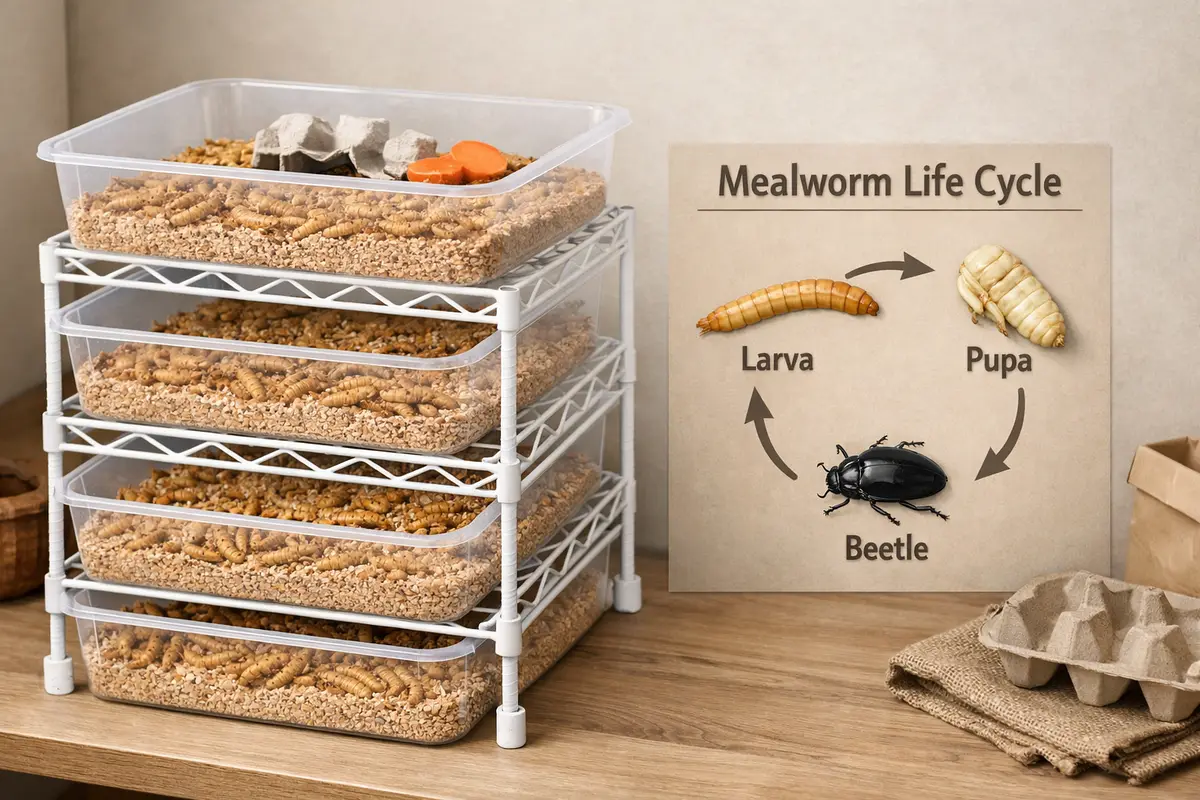
What Is Mealworm Farming? Complete Beginner Guide
Mealworm farming is one of the fastest-growing micro-farming industries in the world. It’s simple, low-cost, eco-friendly, and profitable. Whether you want to supply poultry farms, fish farmers, reptile owners, pet shops, or organic gardeners, mealworms offer a high-protein feed alternative that is becoming more valuable every year. After understanding the concept, follow How to Start Mealworm Farming.
This guide is designed for beginners who want to understand the complete foundation of mealworm farming—from the lifecycle to setup, feeding, temperature management, cleaning, harvesting, drying, and selling. By the end of this article, you’ll know exactly how mealworm farms operate and how you can start one on any scale, whether at home or commercially.
⭐ 1. What Is Mealworm Farming?
Mealworm farming is the practice of raising mealworms (the larvae of the Darkling beetle, Tenebrio molitor) for commercial use. These worms are widely used as:
- High-protein poultry feed
- Fish farming feed
- Reptile and exotic pet feed
- Wild bird feed
- Organic garden fertilizer (mealworm frass)
- Ingredient for pet food companies
- Insect protein research
Unlike traditional livestock, mealworms require: - Very little space
- Minimal feed
- Low maintenance
- No special equipment
- No smell
- No noise
This makes the business ideal for beginners, small spaces, and home setups.
⭐ 2. Why Mealworm Farming Is Growing So Fast
Mealworm production is increasing worldwide because the price of poultry feed has become unpredictable. Farmers need a stable and affordable alternative to soybean meal and fish meal.
Mealworms solve multiple problems:
2.1 High Protein Levels
Dried mealworms contain 48–60% protein, making them one of the most nutrient-rich feeds available.
2.2 Sustainable & Eco-Friendly
They use a fraction of the water and space compared to traditional livestock.
2.3 Low Startup Cost
You can begin with PKR 10,000–30,000 and scale later.
2.4 High Demand Market
Poultry farms, fish farms, reptile keepers, pet shops, and gardeners all buy mealworms regularly.
2.5 No Smell & No Noise
Perfect for home farming inside a room, store, or small building.
⭐ 3. Understanding the Mealworm Lifecycle
The entire success of a mealworm farm depends on understanding the lifecycle:
Egg → Larvae (Mealworms) → Pupae → Beetles → Eggs
Let’s break it down:
3.1 Egg Stage
- Eggs are tiny, white, and almost invisible
- Hatch in 7–14 days
- A single female beetle lays 300–500 eggs
3.2 Larvae Stage (Mealworms) - This is the commercial product
- Duration: 8–10 weeks
- Eats bedding for fast growth
- Needs occasional moisture (carrots, potatoes)
3.3 Pupae Stage - Soft, white, unmoving stage
- Duration: 7–10 days
- Must be separated to avoid cannibalism
3.4 Beetle Stage - Lives 8–12 weeks
- Lays eggs continuously
- Must be kept in a warm, clean container
3.5 Continuous Cycle
A good farm maintains three separate trays: - Larvae tray
- Pupae tray
- Beetle tray
This improves production speed and prevents losses.
⭐ 4. What You Need to Start Mealworm Farming
Mealworm farming is simple. Here’s the basic setup:
4.1 Containers or Trays
Plastic trays, wooden boxes, or drawer-style racks work well.
Ideal tray size:
40x30x10 cm (or similar)
4.2 Bedding Material
This is both food and habitat:
- Wheat bran
- Oat bran
- Crushed oats
- Poultry grower feed mix (optional)
Bedding depth: 4–8 cm
4.3 Moisture Source (Important)
Use low-moisture foods: - Carrots
- Potatoes
- Apple slices
- Cucumbers (small amount)
Never use wet food that rots quickly.
4.4 Temperature Control
Mealworms thrive at:
20–28°C
Below 15°C: they grow slow
Above 32°C: they die
4.5 Ventilation
Good airflow prevents mold and fungus.
Many new farmers ask is mealworm farming profitable, and the answer depends on setup size and management.
⭐ 5. Step-by-Step: How Mealworm Farming Works
Here is the full process designed for beginners:
Step 1: Setup Containers
Prepare three separate trays:
- Beetle tray
- Larvae tray
- Pupae tray
Add bedding to each.
Step 2: Add Starter Colony
Start with: - 500g–1kg larvae
- or 300–500 beetles
This creates a strong base.
Step 3: Provide Regular Food & Moisture
Bedding = food
Moisture = vegetables
Top up bedding every 2–3 weeks.
Step 4: Maintain Temperature
Keep the room stable at 20–28°C.
Step 5: Separate Stages Regularly
Use sifters or by hand: - Move beetles every 1–2 weeks
- Move pupae into a pupae tray
- Move newly hatched worms into larvae trays
Step 6: Harvest Mealworms
Harvest when larvae reach 2–3 cm length.
Step 7: Drying the Mealworms
Two drying methods: - Air drying
- Low-temperature oven drying (70–80°C)
Drying improves storage life and price.
Step 8: Packing & Storage
Store dried worms in: - Airtight jars
- Plastic tubs
- Vacuum bags
Shelf life: 1–2 years
⭐ 6. How Much Does It Cost to Start?
A basic mealworm farm costs:
PKR 10,000 – 30,000
Breakdown:
- Trays: PKR 4,000–8,000
- Bedding: PKR 1,000–2,000
- Starter colony: PKR 5,000–10,000
- Moisture food: Minimal
- Racks (optional): PKR 2,000–5,000
This is one of the cheapest protein-production businesses in Pakistan.
⭐ 7. How Much Can You Earn? (Profit Calculation)
A small home setup produces:
8–12 kg dried mealworms per month
Market rates in Pakistan:
- Wholesale: PKR 1,800–2,500 per kg
- Retail: PKR 2,500–3,200 per kg
Potential Earnings:
PKR 20,000 – 60,000 per month
A bigger setup earns far more.
⭐ 8. Common Beginner Mistakes
Avoid these to keep your colony healthy:
- Keeping all stages in one tray
- Overfeeding moisture (causes mold)
- Temperature too low
- Not separating pupae
- Using airtight containers (lack of airflow)
- Adding rotten fruits
- Not cleaning bedding
These mistakes slow production.
⭐ 9. Who Buys Mealworms?
Mealworms are in demand from:
- Poultry farms
- Fish farms
- Reptile owners
- Pet shops
- Bird feed suppliers
- Organic gardeners
- Compost makers
- Feed mills
This gives you multiple income streams.
⭐ 10. Internal Linking Suggestions
On your website, link this article to:
- “Mealworm Lifecycle Explained”
- “How to Start Mealworm Farming at Home in Pakistan”
- “Mealworm Farming Setup Cost in Pakistan”
- “Mealworm Farming Profit Calculation”
- “How to Sell Mealworms in Pakistan”
This boosts page authority.
⭐ 11. Final Conclusion
Mealworm farming is simple, affordable, and scalable. With basic knowledge of the lifecycle, temperature, feeding, and separation, you can grow a stable colony that generates consistent income. The growth process is detailed in Mealworm Lifecycle Explained. Whether you want to operate at home or expand commercially, mealworm farming is one of the most beginner-friendly agriculture businesses in Pakistan.