
How to Grow Mealworms Faster (Production Boosting Guide for Beginners)
Growing mealworms faster means producing more kilograms per month, increasing your profit, and running your colony efficiently. Whether you’re running a home setup or a small commercial unit, the key to success is speed + survival rate. Fast growth depends on correct feeding explained in Mealworm Feed Ratio Guide.
This complete guide explains how to speed up mealworm growth, how to keep worms healthy, how to increase egg laying, how to reduce losses, and how to optimize your environment for maximum output.
⭐ 1. Why Mealworms Grow Slowly (Common Causes)
Before improving growth, you must understand why worms slow down:
- Low temperature
- Too much moisture
- Poor bedding quality
- Not enough ventilation
- Overcrowded trays
- Beetles and larvae mixed
- Mold in bedding
- Weak nutrition
- Stress from vibration or movement
Fix these issues, and your production increases automatically.
⭐ 2. The Secret Formula for Fast Growth
Mealworms grow fastest when all five conditions are correct:
25°C temperature
Low humidity
High-nutrition bedding
Clean separation
Consistent moisture feeding
If even one factor is wrong, growth slows down.
⭐ 3. Temperature: The #1 Factor for Fast Mealworm Growth
Ideal temperature:
24–28°C
Slow zone:
Below 18°C
Danger zone:
Above 32°C
Mealworms grow 2–3× faster at ideal temperatures.
How to maintain temperature in Pakistan:
Summer:
- Keep trays in a cool room
- Use a fan for ventilation
- Avoid closed rooms without airflow
- Never place trays in sunlight
Winter: - Use room heater on low
- Keep trays away from cold floors
- Wrap trays lightly with cloth
Temperature control = consistent monthly production.
⭐ 4. Bedding Quality Affects Growth Speed
Mealworms eat their bedding.
So bedding is directly linked to growth speed.
Best bedding formula for fast growth:
70% Wheat Bran
20% Oats
10% Grower Feed
This mix provides:
- Balanced fiber
- Protein boost
- Good digestion
- Faster fat gain
- Easier movement for worms
Replace bedding every 3–4 weeks.
Stale bedding slows growth dramatically.
⭐ 5. Moisture Feeding (Hydration Makes Worms Grow Faster)
Mealworms need moisture to digest food properly.
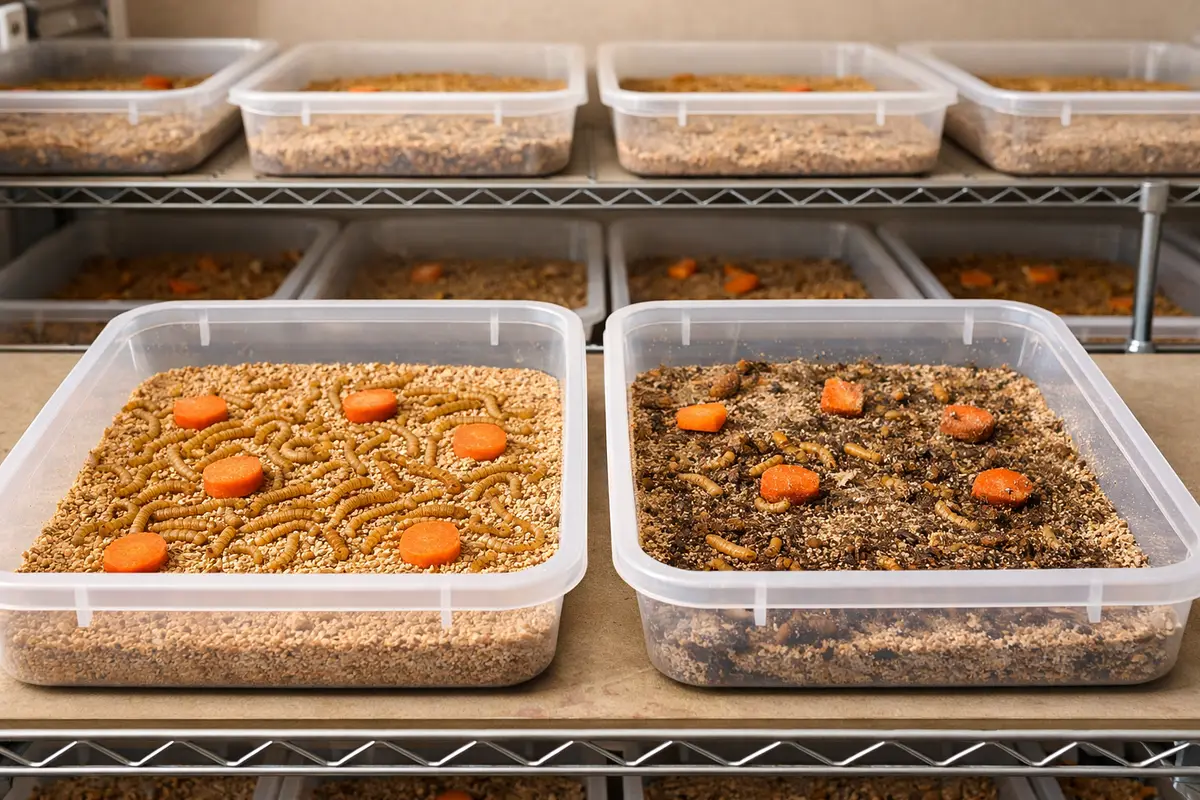
Best moisture foods for fast growth:
- Carrots (best)
- Potatoes
- Apples (small amount)
- Cucumbers (very small amount)
Moisture feeding schedule:
2–3 times per week
Tips: - Always place moisture on top
- Never bury moisture
- Remove leftovers within 24–48 hours
- Cut slices small
Hydrated worms grow 30–40% faster.
⭐ 6. Ventilation & Airflow Improve Growth
Good airflow prevents:
- Mold
- Ammonia buildup
- Moist bedding
- Bacteria growth
How to ensure good airflow: - Use open trays
- Avoid airtight lids
- Keep room ventilated
- Don’t overcrowd trays
Better ventilation = stronger worms.
⭐ 7. Tray Management (Critical for Fast Growth)
One of the biggest mistakes beginners make:
Keeping all stages (larvae, pupae, beetles) in the same tray.
This slows everything down.
Always separate stages:
Larvae Tray
Pupae Tray
Beetle Tray
Why separation increases growth:
- Larvae stay stress-free
- Beetles lay more eggs
- Pupae don’t get eaten
- Bedding stays cleaner
- Temperature stays consistent
Separation alone can double your production.
⭐ 8. Avoid Overcrowding (Most Common Beginner Problem)
Overcrowded trays cause:
- Slow growth
- Stress
- Food shortages
- High mortality
- More smell
- Faster bedding contamination
Ideal density:
1 kg of worms per 40×30×10 cm tray
OR
200–300g beetles per tray
If trays look too full, divide them.
⭐ 9. Weekly Maintenance for Fast Growth
Follow this weekly routine:
- Stir bedding lightly
Improves airflow. - Remove moisture leftovers
Prevents mold. - Remove dead worms
Stops contamination. - Add fresh moisture
Keeps colony hydrated. - Check pupae and beetles
Separate daily.
Consistency = speed.
⭐ 10. How to Increase Beetle Egg Laying (Production Booster)
More eggs = more worms = more monthly harvest.
Boost beetle productivity by:
- Using soft, fine bedding
- Adding carrot every day
- Keeping beetle trays warm (26–28°C)
- Moving beetles to new bedding every 10–14 days
- Keeping trays dark
- Avoiding tray disturbance
Strong beetles produce 500+ eggs each.
⭐ 11. How to Grow Larger Mealworms
Bigger larvae look better to buyers and become premium dried worms.
To grow bigger mealworms:
- Use deeper bedding (6–8 cm)
- Keep temperature stable
- Avoid overcrowding
- Provide regular moisture
- Use the bedding mix formula
- Give small apple slices once a week
Healthy worms = higher selling price.
Scaling production becomes easier once you understand how to grow a mealworm farm gradually and safely.
⭐ 12. How to Prevent Growth Problems
Growth stops when conditions are wrong.
Common problems and solutions:
Problem 1: Worms turning black
Cause: Too much moisture or poor bedding
Fix: Replace bedding, reduce moisture
Problem 2: Worms thin and weak
Cause: Low nutrition
Fix: Add grower feed (10–20%)
Problem 3: Slow growth in winter
Cause: Low temperature
Fix: Maintain 22–25°C
Problem 4: Mold in bedding
Cause: Excess moisture
Fix: Use carrots, increase airflow
Problem 5: Worms escaping trays
Cause: High moisture, overcrowded, shallow trays
Fix: Use deeper trays and reduce moisture
⭐ 13. How to Boost Growth Using Professional Tricks
These pro strategies are used by high-production farms.
⭐ 13.1 Pre-dry your vegetables
Leave carrot slices exposed for 2–3 hours before feeding.
Reduces moisture risk.
⭐ 13.2 Use dark rooms
Mealworms grow faster in darkness.
⭐ 13.3 Add protein boosters (small amount)
- Soybean meal (5–10%)
- Grower feed (10–20%)
Do NOT overdo it — bedding must stay dry.
⭐ 13.4 Keep bedding fluffy
Soft bedding = faster movement = better feeding.
⭐ 13.5 Rotate trays weekly
Move worms to fresh bedding early.
Fresh food always speeds growth.
⭐ 14. Ideal Growth Schedule (Complete Timeline)
Eggs → Hatch
7–14 days
Larvae → Grow
6–10 weeks
Larvae → Pupae
7–10 days
Pupae → Beetles
7–10 days
Beetles → Eggs
Starts within 3–7 days
Faster growth comes from stable conditions.
⭐ 15. Internal Linking Suggestions
Link this article to:
- “Mealworm Feeding Guide”
- “Best Bedding for Mealworms”
- “How to Separate Larvae, Pupae & Beetles”
- “Mealworm Farming Profit Calculation”
- “Mealworm Farming at Home in Pakistan”
⭐ 16. Final Conclusion
Growing mealworms faster is all about creating the right environment—stable temperature, clean bedding, controlled moisture, good ventilation, and proper separation. When managed correctly, your mealworms grow bigger, stronger, and faster, leading to higher monthly production and better profits. Breeding control is detailed in Mealworm Lifecycle Explained.
Implementing these professional techniques will help you scale quickly, reduce losses, and maintain a healthy colony all year round. Whether you’re a beginner or building a commercial farm, these tips give you a major advantage in Pakistan’s growing mealworm industry.