
Mealworm Feeding Guide: What They Eat & What to Avoid (Complete Beginner Guide)
Feeding mealworms the right way is one of the most important parts of successful mealworm farming. Good feeding leads to faster growth, stronger beetles, higher egg production, and better-quality dried mealworms. Poor feeding slows down the entire colony and leads to stunted worms, mold problems, and high mortality. Feeding works best when trays are set correctly in Mealworm Tray Setup Guide.
This complete mealworm feeding guide explains what mealworms eat, how much to feed them, moisture sources, feeding frequency, what to avoid, and how to create a high-quality diet for maximum production.
Let’s start with the basics.
⭐ 1. What Do Mealworms Eat?
Mealworms eat dry grain-based foods and small amounts of moisture-rich vegetables. Their diet must be:
- Dry
- Clean
- Mold-free
- Nutrient-rich
Mealworms naturally eat: - Wheat bran
- Oatmeal
- Oat bran
- Crushed corn
- Wheat flour
- Cereal grains
- Dry flakes
These foods form their main diet.
⭐ 2. Dry Foods (Primary Diet)
Dry foods are the foundation of mealworm feeding. They provide the nutrients needed for growth and development.
Below are the best dry foods.
⭐ 2.1 Wheat Bran (Best Overall Food)
Wheat bran is the most common and effective food for mealworms.
Benefits
- Cheap
- Easily available in Pakistan
- Good fiber content
- Encourages healthy growth
Recommended for:
All stages: larvae, beetles, and hatchlings.
⭐ 2.2 Oat Bran
A premium option for mealworm feeding.
Benefits
- High nutrition
- Soft texture
- Faster growth
⭐ 2.3 Rolled Oats / Crushed Oats
Mealworms love crushed oats.
Benefits
- Nutrient-rich
- Minimal dust
- Good for larvae and beetles
⭐ 2.4 Poultry Grower Feed (Supplement Only)
Grower feed is good but shouldn’t be used alone.
Use only 20–30% mix with bran
Why?
Grower feed can compact and cause clumps.
⭐ 2.5 Cornmeal
A fine powder that worms love.
Benefits
- Soft texture
- Good alternative food
- Good for small worms
Warning
Cornmeal clumps with moisture — use carefully.
⭐ 2.6 Multi-Grain Mix (Pro Formula)
For fastest growth, use this mix:
70% Wheat Bran + 20% Oats + 10% Grower Feed
This formula is used by professional mealworm farms.
⭐ 3. Moisture Foods (Essential for Hydration)
Mealworms need water, but you cannot give them actual water. Instead, give them moisture through vegetables or fruits.
Best Moisture Foods:
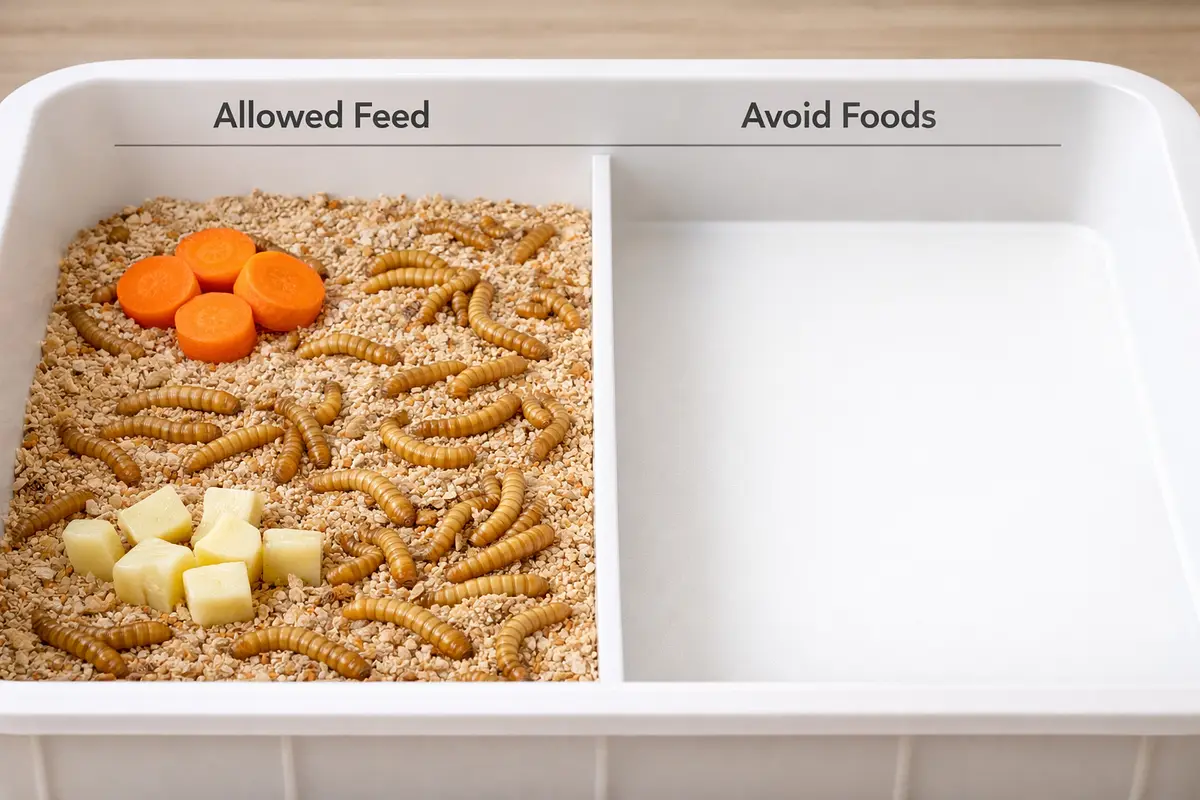
- Carrots
- Potatoes
- Apples
- Cucumbers (in small amounts)
⭐ 3.1 Carrots (Best Moisture Food)
Carrots are the safest moisture source.
Benefits
- Don’t rot quickly
- Don’t smell
- Long-lasting
- High vitamin content
⭐ 3.2 Potatoes
Soft and safe option.
Benefits
- Slow moisture release
- Less mold risk
⭐ 3.3 Apples
Mealworms love apples.
But: Apples rot fast
So use very small slices to avoid mold.
⭐ 3.4 Cucumber
Very high water content.
Use small pieces only
Too much cucumber = wet bedding + mold.
⭐ 4. Feeding Schedule (How Often to Feed)
Moisture Feeding:
2–3 times per week
Dry Bedding Feeding:
Replace bedding every 3–4 weeks
Beetles Feeding:
Small moisture piece daily or every other day
Larvae Feeding:
Moisture slices 2–3 times weekly
⭐ 5. How Much Moisture Should You Give?
Moisture food quantity depends on the tray size.
For a medium-sized tray:
- 2–3 small carrot slices
- OR 1–2 potato slices
- OR 2–3 small apple pieces
Never bury moisture food in bedding.
Always place it on top.
⭐ 6. How to Prevent Mold While Feeding
Mold is the biggest danger in mealworm farming.
Tips to avoid mold:
- Use carrots as main moisture source
- Don’t leave fruit for more than 24–48 hours
- Improve ventilation
- Keep trays in a dry room
- Don’t place moisture food on edges
- Replace bedding when damp
Following these tips keeps your colony safe and productive.
⭐ 7. Feeding Mealworms at Different Life Stages
Mealworms need different feeding approaches depending on their stage.
Local climate and demand make it practical to learn how to start mealworms farming in Pakistan with minimal investment.
⭐ 7.1 Feeding Eggs
Eggs don’t need food. They stay inside bedding and hatch naturally.
⭐ 7.2 Feeding Larvae (Mealworms)
Larvae need:
- Deep bedding (6–8 cm)
- Moisture slices (2–3 times weekly)
- Fresh bran every 3–4 weeks
Larvae are heavy eaters during late growth stages.
⭐ 7.3 Feeding Pupae
Pupae do not eat at all.
Keep them in dry trays.
⭐ 7.4 Feeding Beetles
Beetles need:
- Fresh bedding every 10–14 days
- Moisture slices daily (to increase egg production)
- Soft bedding for egg laying
A hydrated beetle = high egg production.
⭐ 8. Foods You Should Avoid (Very Important)
Some foods are dangerous for mealworms.
❌ 8.1 Citrus Fruits (Lemon, Orange)
High acidity kills worms.
❌ 8.2 Tomatoes
Too much moisture → instant mold.
❌ 8.3 Wet Grass or Leaves
Wet vegetation rots quickly.
❌ 8.4 Watermelon or Melon
Very high water → bedding disaster.
❌ 8.5 Any Moldy Food
Never feed rotten vegetables.
❌ 8.6 Meat or Protein Sources
Mealworms do not need meat.
❌ 8.7 Milk or Dairy
Completely unsafe.
⭐ 9. Feeding Tips for Maximum Growth
These tips help mealworms grow big and healthy.
⭐ 9.1 Keep Bedding Fresh
Replace every 3–4 weeks.
⭐ 9.2 Use High Nutrition Mix
70% bran + 20% oats + 10% grower feed.
⭐ 9.3 Keep Moisture Slices Small
Small slices = low moisture buildup.
⭐ 9.4 Spread Moisture Evenly
Don’t place in corners.
⭐ 9.5 Maintain 20–28°C
Ideal temperature = fast growth.
⭐ 9.6 Stir Bedding Weekly
Improves airflow.
⭐ 9.7 Sift Bedding Frequently
Keeps worms clean and healthy.
⭐ 10. Common Feeding Mistakes to Avoid
❌ Overfeeding moisture
Causes mold.
❌ Using too much apple or cucumber
Raises humidity.
❌ Keeping moisture food too long
Rotting vegetables cause smell and pests.
❌ Not cleaning trays
Harmful bacteria grow.
❌ Using fine flour as bedding
Blocks worm breathing.
⭐ 11. Feeding in Pakistan’s Climate (Hot & Humid Months)
Pakistan’s summers are tough on worms.
Best practices:
- Use carrots instead of apples
- Keep trays away from sunlight
- Improve ventilation
- Use fans or cool rooms
- Keep moisture slices small
- Replace bedding faster (every 2–3 weeks)
These tips prevent bad smell, mold, and overheating.
⭐ 12. Feeding in Winter (Cold Months)
Mealworms eat less in winter.
Tips:
- Keep room warm (20–25°C)
- Feed small moisture twice a week
- Avoid heavy fruits in winter
- Use bran with grower feed to boost nutrition
Winter farming is easier than summer farming.
⭐ 13. Internal Linking Suggestions
Link this article to:
- “Best Bedding for Mealworms”
- “Mealworm Lifecycle Explained”
- “How to Grow Mealworms Faster”
- “Best Trays for Mealworm Farming”
- “Mealworm Farming at Home in Pakistan”
⭐ 14. Final Conclusion
Mealworms are easy to feed, but they need the right combination of dry bedding and controlled moisture to grow properly. Wheat bran remains the best and most affordable food source in Pakistan. Mixing oats and grower feed creates a balanced, nutrient-rich diet that supports rapid growth and high egg production. For quantity planning, use our Mealworm Feed Ratio Guide.
Always manage moisture carefully, avoid high-water fruits, and maintain clean bedding. With proper feeding practices, you’ll produce healthier worms, stronger beetles, and higher monthly yields — leading to better sales and higher profit.